A practice built on asking better questions.
My academic work focuses on the patient experience: developing validated outcome measures, refining surgical technique, applying machine learning to objective assessment, and teaching the next generation of ophthalmologists. The aim is consistent: to make care measurable, reproducible and clearly accountable to the people in front of us.
As a section editor for the journal Eye, I believe in clinician-led research and an up-to-date, evidence-based practice, so I can offer my patients the best care available. My published work spans the breadth of oculoplastic, lacrimal and orbital surgery; grouped below are the themes you are most likely to recognise from your own care, each with the studies behind them.
Measuring what matters in watery eye.
A watering eye is common and surprisingly hard to measure well. Much of my research builds a shared language for it, so treatments can be compared fairly and the things that matter to patients are captured properly.
A clinician-completed assessment that captures the anatomical and functional drivers of a watering eye, designed to standardise lacrimal evaluation and guide management.
A validated patient-reported outcome measure for epiphora, built to measure what matters most to patients and to standardise reporting when comparing treatments. It is now used in multiple centres nationally and increasingly internationally.
- The watery eye quality of life (WEQOL) questionnaire: a patient-reported outcome measure for surgically amenable epiphoraEye 2021
- The 'TEARS' score: a tool for grading and monitoring epiphoraEuropean Journal of Ophthalmology 2022
- A systematic review of patient-reported outcomes for surgically amenable epiphoraOphthalmic Plastic & Reconstructive Surgery 2017
- Evaluating the effectiveness of lacrimal gland botulinum toxin using the TEARS scoreOphthalmic Plastic & Reconstructive Surgery 2024
“Good outcomes are not only subjective opinions, they need to be measurable. This is what is lacking most when trying to compare which treatment is best for patients with watery eyes. The aim, therefore, is to build a tool that measures what matters most to patients.”
Refining eyelid surgery
Eyelid operations are among the most common procedures I perform. This work tests the techniques and materials used in ptosis, entropion and ectropion repair, so corrections are more reliable and the results last.
“97% of patients reported being satisfied with the outcome of their surgery.”
- Ex vivo biomechanical comparison of silicone sling securing methods for frontalis ptosis repairOphthalmic Plastic & Reconstructive Surgery 2025
- An evaluation of surgical outcomes following tarsal ectropion repair: a multi-centre retrospective cohort studyEuropean Journal of Ophthalmology 2025
- 8-0 polyglactin 910 suture in entropion repair: long-term follow-up and rates of recurrenceEye 2022
- Anterior approach white line advancement: technique and long-term outcomes in the correction of blepharoptosisEye 2017
- Lower eyelid involutional entropion following cataract surgeryEye 2021
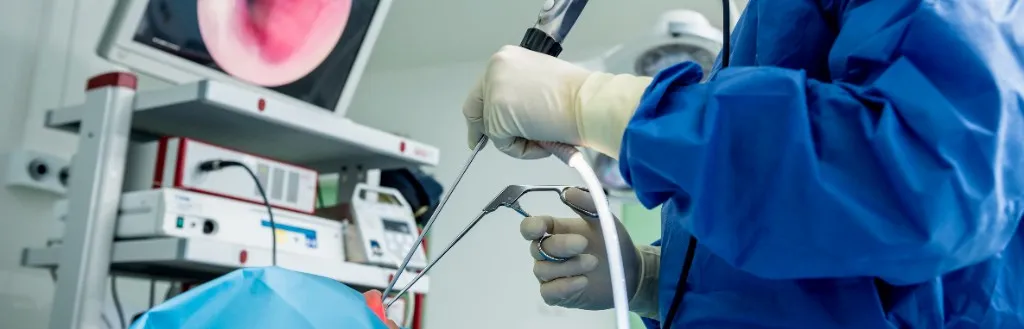
Advancing tear-duct surgery
Tear-duct surgery depends on precise work in a small, hidden space. These studies examine the relevant anatomy and instruments to make keyhole (endoscopic) surgery safer and more effective.

Objective measurement and imaging
I am interested in how technology can make assessment more objective. This research applies machine learning and advanced imaging to measure things the human eye struggles to judge consistently.
“Eyelid function is a dynamic process, and therefore lends itself more to video assessment versus photography.”
- Automated extraction of clinical measures from videos of oculofacial disorders using machine learning: feasibility, validity and reliabilityEye 2023
- A case-control study of volumetric segmentation of extraocular muscles from MRI images in thyroid eye diseaseEuropean Journal of Ophthalmology 2025
- MR dacryocystography: optimising a dynamic imaging protocol for patients with epiphoraRadiography 2025
- Optical frequency domain imaging (OFDI) represents a novel technique for the diagnosis of giant cell arteritisEye 2024
Reconstruction and periocular disease
When skin cancer or serious infection affects the eyelids and socket, careful reconstruction matters. These studies cover techniques for complex repair and the management of demanding periocular conditions.
- A severe case of periorbital necrotising fasciitis and successful management using Pelnac dermal substituteEuropean Journal of Ophthalmology 2025
- Slow Mohs surgery for the treatment of periocular basal cell carcinomas: three and five year follow-upActa Ophthalmologica 2019
- Novel use of an autologous scleral button graft to close the anterior defect in evisceration surgeryOrbit 2023
- A conservative approach to periocular necrotising fasciitis with paranasal sinus involvementEuropean Archives of Oto-Rhino-Laryngology 2017
“Each case raises a question. Following that question is how technique improves.”
Teaching and education research
Good clinicians are made, not born. Alongside clinical work I study how we teach and assess core skills, from examining the back of the eye to learning surgical anatomy through dissection.
- The value of clinical practice in cadaveric dissection: lessons learned from a course in eye and orbital anatomyJournal of Surgical Education 2016
- Addressing the 'forgotten art of fundoscopy': evaluation of a novel teaching ophthalmoscopeEye 2016
- A novel device for teaching fundoscopyMedical Education 2014
- Factors associated with confidence in fundoscopyThe Clinical Teacher 2014
- Trends in ophthalmology journals: a five-year bibliometric analysis (2009-2013)International Journal of Ophthalmology 2016
Education at every level.
Teaching is a core part of my role at Portsmouth and within the wider oculoplastic community. I enjoy the conversations as much as the curriculum.
Undergraduate Co-Lead for Ophthalmology
Lead for ophthalmology education across the medical school at the University of Portsmouth (King's College London branch).
Fellowship supervisor
We have established an international oculoplastic fellowship to train the next generation of subspecialists.
Faculty member
Regular invited faculty member and speaker for national oculoplastic, lacrimal and orbital teaching courses.
Clinical and academic supervisor
I regularly supervise medical students, junior doctors and trainee ophthalmologists in both clinical care and academic settings.
My fullpublication list.
This is my complete publication list, updated automatically from my ORCID record.
Full record on ORCID