Why do my eyelids look heavy?
Heavy upper eyelids are rarely caused by one thing. A Roman blind analogy for the three components that droop with age, and why treating only the obvious one disappoints.
A gentleman in his late sixties came to my clinic having been told for a decade that his heavy eyelids were “just age.” He had stopped driving at night because his eyelids felt as if they were closing on him by the end of the day. He held his head tipped back to read. His grandchildren had taken to calling him sleepy. He thought he was being vain even asking about it.
When I examined him, three different things were contributing to the heaviness, each one minor on its own but collectively significant. A single combined operation lifted his eyelids back to where they had been twenty years earlier, restored his ability to drive at dusk, and stopped him tipping his head back. He told me afterwards that the difference was less about appearance and more about no longer feeling tired all the time.
This is a common pattern. Heavy upper eyelids are rarely caused by one thing. They are usually caused by three things at once, in different proportions, and treating only the most obvious one can be disappointing.
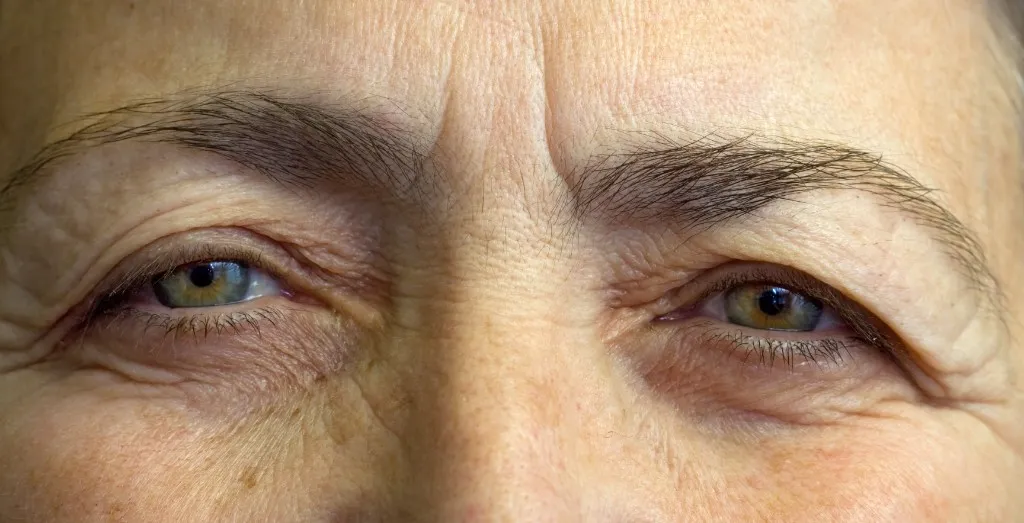
Excess skin, a low brow, and a drooping lid margin often coexist; the dominant contributor is not always obvious at a glance.
Think of the upper eyelid as a Roman blind
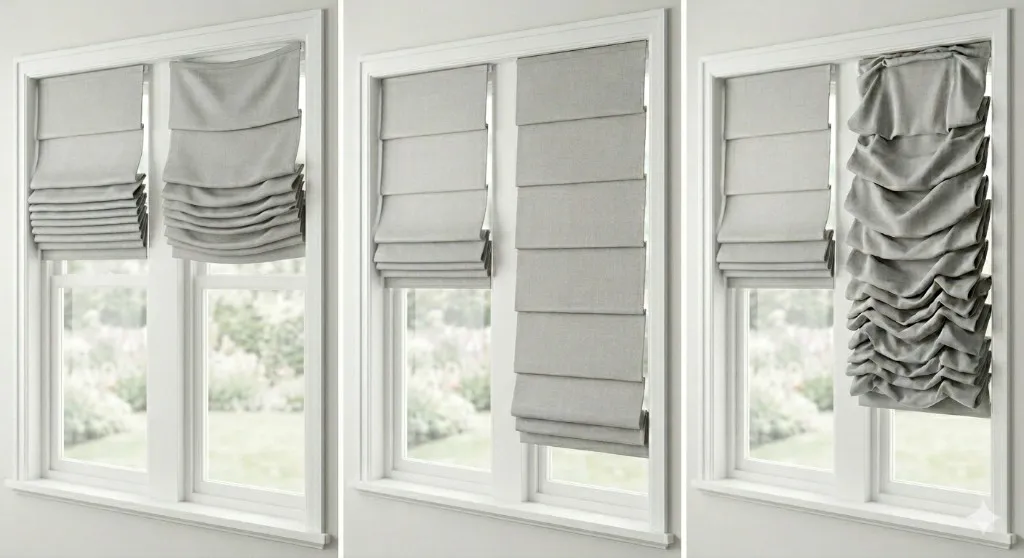
The top rail is the brow; the pleated fabric is the eyelid skin; the cord is the levator muscle that raises the lid. Any of the three can fail with age, and most patients have a bit of all three.
There are three components stacked above the eye, and any of them can fail.
The top rail is the eyebrow. It sits on the bone above the eye, fixed and structural, and provides the upper boundary. If the rail drops, everything below it drops too.
The fabric is the eyelid skin. When the blind is raised, the fabric pleats neatly into the lid crease. Over time the skin loses elasticity and there is too much of it for the frame, so the pleats become folds that bunch and hang over the lashes.
The cord is the levator muscle. This is the muscle inside the eyelid that raises it every time you open your eye, just as the cord on a Roman blind raises the fabric. It can stretch or detach from the eyelid plate over the years, and when it does, the blind sits lower than it should.
Each of these has a name in clinical language: brow ptosis (rail), dermatochalasis (fabric), and ptosis (cord). When they happen together, which is common, the eye looks small and tired and the field of vision is genuinely reduced.
How they overlap and confuse each other
A common scenario is a patient who looks as if they have a lot of excess skin, but on closer examination most of the apparent skin overhang is actually a low brow pushing the skin down. Removing the skin without addressing the brow leaves a strange tension in the upper face and a result that does not last.
The reverse is also true. A patient with a clear ptosis can be told their problem is excess skin, and a blepharoplasty alone leaves the eyelid still drooping, sometimes more obviously than before.
This is why the assessment is the most important part of the visit. I measure the position of the upper eyelid margin against the pupil, the strength of the levator muscle, the height of the brow, and the amount of true excess skin. I take photographs in primary gaze and with the eye open and closed. I check for any underlying conditions such as thyroid eye disease or myasthenia, which can mimic involutional ptosis.
How I treat each component
There is no single operation that suits everyone, and the right plan depends on which layers are involved and to what degree.
For excess skin (dermatochalasis), an upper blepharoplasty. This removes a precise crescent of skin and, where appropriate, a small amount of underlying muscle and fat. The scar sits in the natural lid crease and usually fades to a fine line by three months.
For ptosis, the choice depends on severity, age, and whether a blepharoplasty is also needed. I keep four techniques in regular use:
- Anterior approach white line advancement. This is my preferred approach when a blepharoplasty is also needed, which is most of the time. It uses the same skin incision as the blepharoplasty, which means no extra scar, and it gives reliable, adjustable lift. The technique avoids disturbing the deeper anatomical layers that some other techniques breach, which appears to give a more natural eyelid contour. We reported long-term outcomes in Eye in 2017, with a success rate of 91.5 percent maintained at more than two years of follow-up, and 96 percent of patients satisfied with the result (Schulz et al., PubMed link).
- Müller’s muscle conjunctival resection (MMCR). A posterior approach done from inside the eyelid, with no external scar. I tend to use this for younger patients or for milder ptosis where a blepharoplasty is not needed.
- Posterior approach white line advancement. When more lift is needed than MMCR can reliably deliver, but a blepharoplasty is still not indicated.
- Other posterior approaches for cases with conjunctival or fornix issues that need addressing at the same time.
This is not a long list because no list is. Each technique has its place, and the choice depends on what the eyelid actually needs rather than on what I happen to prefer doing.
For brow ptosis, the options are more of a compromise. A direct brow lift, with a small incision just above the eyebrow hair, gives the most reliable and longest-lasting result, but leaves a fine scar. A pretrichial brow lift, with the incision at the hairline, hides the scar better but can be less durable. An endoscopic brow lift uses keyhole incisions hidden in the hair but is technically demanding and the lift tends to relax over the years. An internal browpexy can be done through a blepharoplasty incision and gives a modest, supportive lift suitable for mild brow ptosis combined with other procedures.
I am honest with patients that brow ptosis is the hardest part of the upper face to fix in a way that lasts. The choice between scar and durability is a real one, and the right answer depends on the patient’s priorities and skin type.
When all three are present
When ptosis, dermatochalasis, and brow ptosis coexist, I usually treat them in the same operation. The order matters: brow first, then ptosis, then skin, so that each step is built on a stable foundation. Doing them piecemeal across multiple operations is sometimes necessary but usually less satisfactory.
Most upper eyelid surgery in my practice is done under local anaesthetic with light sedation, as a day case. The advantage of local anaesthetic is that I can ask the patient to open and close their eyes during the operation, which lets me fine-tune the height of the eyelid in real time.
What to expect afterwards
There is bruising and swelling for the first one to two weeks, occasionally longer in older patients. The eyelid often looks slightly over-corrected for a few weeks while the swelling settles. Most patients are presentable by three weeks and at a final result by three months.
Risks include asymmetry between the two sides, under-correction or over-correction, dry eye in the early weeks, and rarely a more significant complication. I discuss all of these in detail before the operation. Asymmetry of one to two millimetres is common and usually settles, but a small number of patients need a minor adjustment in clinic afterwards, and I would always rather adjust than over-promise.
When it is worth being seen
If you find yourself raising your brows or tipping your head back to see, if your peripheral vision feels reduced, if you look more tired than you feel, or if you have been told the problem is “just age” but it is interfering with reading, driving, or work, an oculoplastic assessment is worthwhile. Many patients qualify for surgery on functional grounds, not cosmetic, when the eyelid is genuinely obstructing the visual field.
A careful examination can usually distinguish what is contributing to the heaviness within a single visit. Knowing which of the three layers is the dominant problem is the difference between a result that lasts and one that disappoints.
Procedure pages this note touches on.
Repositioning a heavy or asymmetric brow, often the missing piece when upper blepharoplasty alone does not give the result you are after.
A drooping upper eyelid that obstructs vision, causes brow ache or simply looks tired. Surgery to lift the eyelid is highly successful when planned around your individual anatomy.
Removal of excess upper-lid skin and (where appropriate) a small amount of fat, refreshing the upper eye, opening up the gaze and lifting heavy lids.
Other recent notes.
Is eyelid surgery funded on the NHS?
There is no national rule. Whether an eyelid operation is paid for depends on which operation it is and which integrated care board your postcode sits in, and neighbouring boards reach opposite answers on the same patient. Here is how to find out where you stand.
Upper eyelid surgery: there's more than meets the eye
Almost every patient asks for "just a bit of skin taken off". The operation is straightforward; deciding how much to remove, from where, and whether the eye can tolerate it is where the result is actually determined.