Summary
Upper-eyelid skin loosens and droops with age. Upper blepharoplasty removes that excess skin (and, where needed, a small wedge of fat or muscle) through an incision hidden in the natural eyelid crease. The result is a more open, rested eye while preserving the shape and character of the lid.
Who is this for?
Common reasons people consider upper blepharoplasty:
- excess skin resting on the lashes or making make-up difficult to apply,
- a tired, hooded appearance not relieved by rest,
- a ‘heavy’ feeling in the upper eyelids by the end of the day,
- asymmetry between the two upper lids.
Where a low eyelid edge (ptosis) is the dominant problem, ptosis surgery or a combined procedure may be more appropriate.
Is this funded on the NHS?
Hooding with no functional consequence is not an NHS indication anywhere in England, so if the concern is purely how the lids look, this is private surgery. Where the excess skin is genuinely obstructing your vision the answer depends on your area, and in Hampshire it is unusually strict: under Policy 52, NHS Hampshire and the Isle of Wight does not normally fund surgery for dermatochalasis at all, with no visual field threshold offered and an individual funding request as the only route. The exception is the North East Hampshire locality (Aldershot, Farnborough, Fleet, Yateley and Hartley Wintney), which kept the Frimley criteria when it transferred into the board in April 2026 and can fund the same operation. Almost every other board in England does publish a route, usually a documented loss in the upper part of the visual field, but that test is written differently almost everywhere: twenty degrees on one board, thirty on another, a percentage on a third. There is no national number, so check your own postcode rather than a figure you have read somewhere. I have compiled what each board publishes for upper-lid surgery, with the policy it came from and the date it was read.
I see NHS and private patients in the same unit at Queen Alexandra Hospital. If your area does not fund the operation, if you do not meet the published criteria, or if you would rather not wait, that is a private consultation. The same applies if you want the functional problem and the appearance treated together, which the NHS will not do.
What the procedure involves
The operation is performed under local anaesthetic, with or without light sedation, as a day case. A precise incision is marked in the natural eyelid crease, the excess skin is removed, and a small amount of fat is sculpted if needed. The skin is closed with a fine running suture.
Each side typically takes 30 to 45 minutes.
Before and after
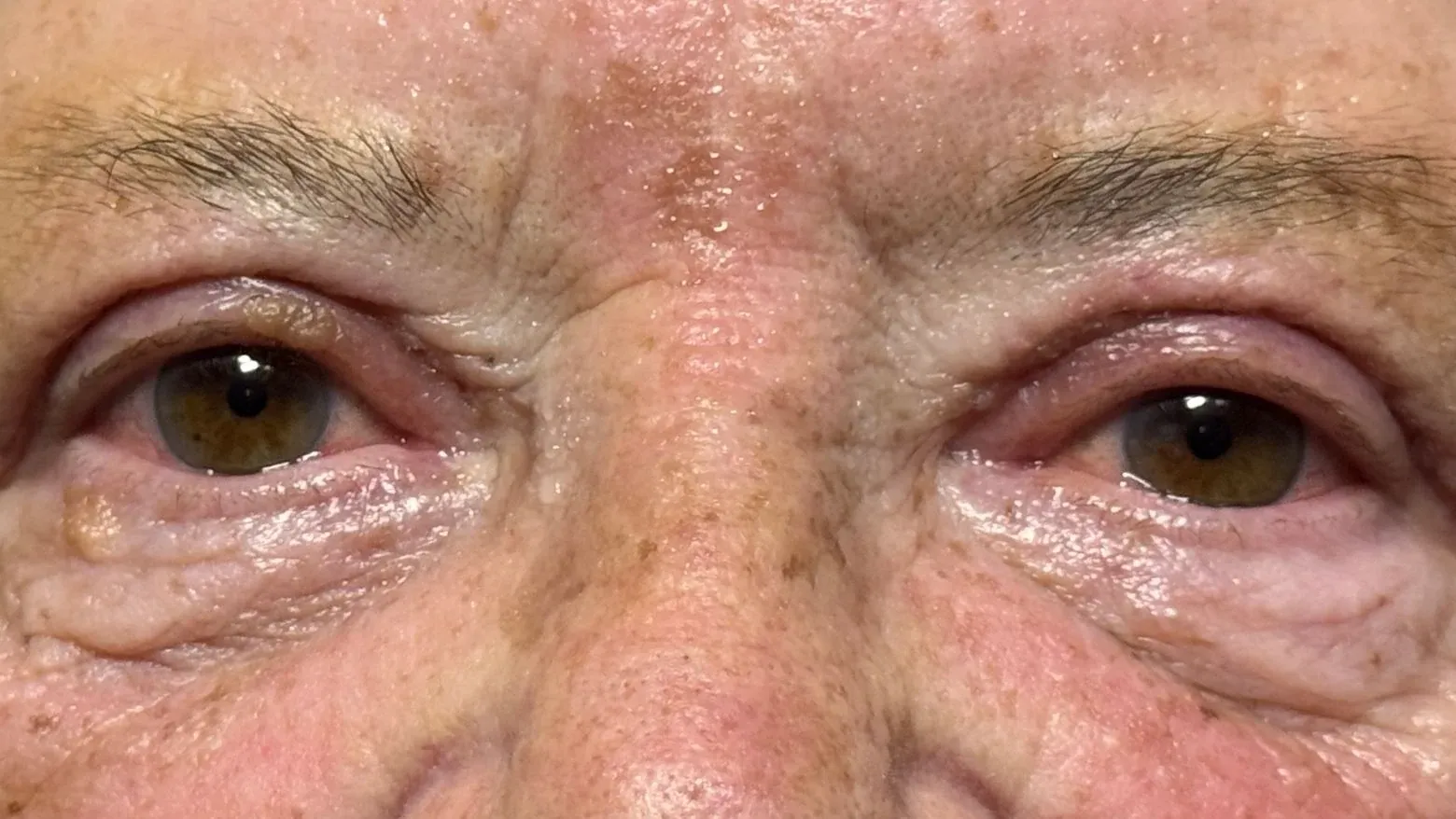
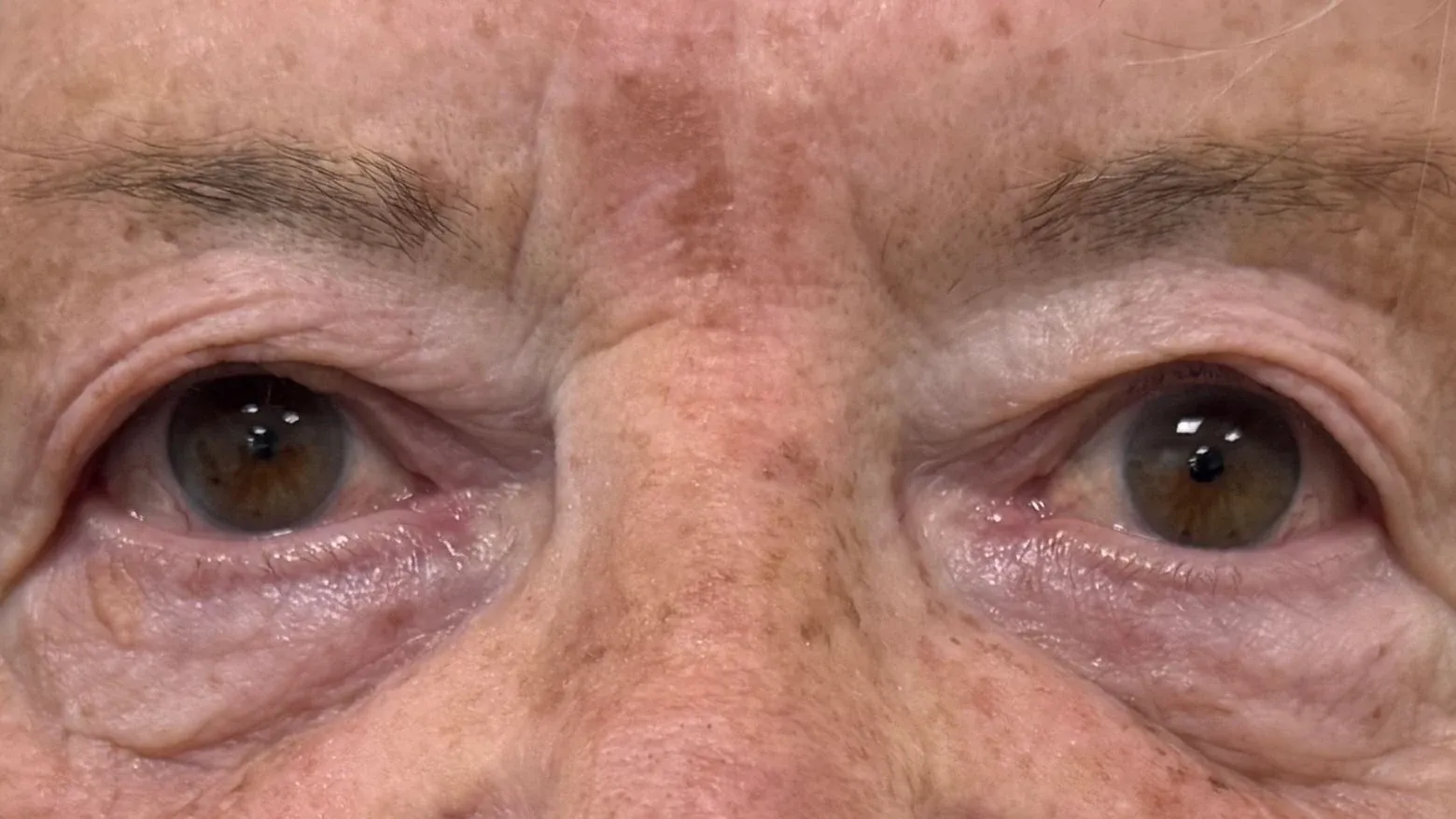
Two weeks is deliberately early to show. It is the point at which most patients are back to normal life, and it is more useful than a polished three-month photograph for setting expectations about what the first fortnight actually looks like.
Recovery and what to expect
- Day 0 to 3: bruising and swelling (expected). Cool compresses help.
- Day 7: sutures removed.
- Week 2: most patients are happy to return to work and social activities.
- Month 2 to 3: scars settle into a virtually invisible line within the crease.
I provide written aftercare instructions and a direct point of contact for any concerns.
Risks and alternatives
Risks include bleeding, bruising, asymmetry, dry eye, scarring and (very rarely) injury to the underlying structures. The risk of any serious complication is very low in experienced hands.
Non-surgical alternatives (anti-wrinkle injections to the brow, fillers) have a limited role for true skin excess. They cannot replace surgery for marked dermatochalasis.