When the tear duct is partly blocked: which operation, and does it last?
A syringing test that passes proves the pipe is not sealed shut. It does not prove it works. Why partial and functional tear duct obstruction is so often dismissed, what the two operations for it are, and why they look identical at three months and very different at eight years.
There is a group of patients I see who have been told, more than once, that there is nothing wrong with their tear ducts.
They water constantly. They dab at their eyes through every conversation. They avoid the wind, avoid reading for long, and are quietly embarrassed by looking as though they have been crying. And when someone flushes their tear ducts with a syringe, the fluid goes down. The ducts are open. They are told the drainage system is fine.
The drainage system is not fine. It is open but it is not working.
This is one of the most frustrating diagnoses in my field to have, and one of the most satisfying to treat properly, because the people who reach me have usually spent years being told their problem does not exist.
Open is not the same as working
If you have read the page on watery eyes, you will remember the sink analogy: the eye overflows either because the tap is on too high, the plug hole is too narrow, the pipe below is blocked, or the sink itself is the wrong shape to funnel water towards the drain.
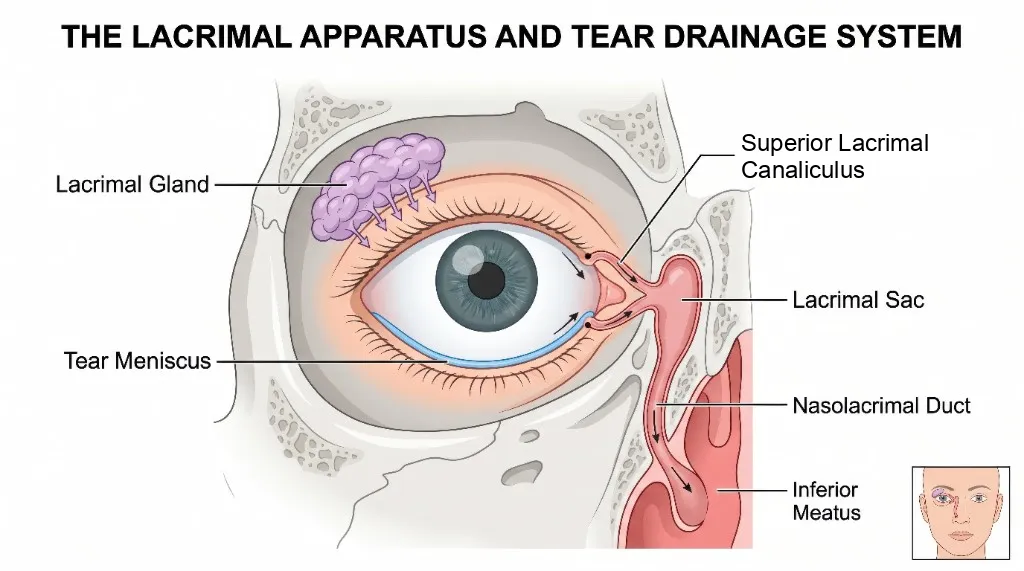
The tear drainage pathway. Tears are made above the eye, swept across it by blinking, and collected at the inner corner, where they pass through the canaliculi into the tear sac and then down the nasolacrimal duct into the nose. The problem described here sits in the lower part of that pathway.
The pipe below, the nasolacrimal duct, is not simply open or closed. It can be:
- Completely blocked. Nothing passes. This is the classical blocked tear duct, easy to diagnose, and reliably fixed by surgery.
- Partly blocked (partial obstruction). The channel is narrowed. Fluid forced through under pressure from a syringe goes down, but the small, gentle volume of everyday tears does not.
- Functionally obstructed. The channel is anatomically open, and yet tears still do not drain. The pumping mechanism, the lining of the duct, or the way the eyelid delivers tears to the drain is not doing its job.
These last two are often grouped together as functional and partial nasolacrimal duct obstruction. They are the reason a syringing test can be reassuring and completely misleading at the same time. A syringe delivers fluid at a pressure your tears will never generate. Passing that test proves the pipe is not sealed shut. It does not prove the pipe works.
The first honest thing to say
Surgery for a partly blocked or poorly functioning duct is less reliably successful than surgery for a completely blocked one.
That is worth stating plainly, because patients are often quoted the success rates for classical blocked tear duct surgery, which are excellent, and reasonably assume the same applies to them. It does not. In our own series of just over 100 patients, around 86 percent reported their symptoms improved, but only around 60 percent described them as completely resolved.
Improvement is not the same as cure, and for this particular problem improvement is the more realistic goal.
The two operations
There are two established options, and they are very different in principle.
Nasolacrimal intubation. A soft silicone tube is threaded through the existing tear drainage channel and left in place for a few months, then removed. The idea is to splint the narrowed passage open and let it heal in a wider configuration. It is the smaller of the two operations: no skin incision, nothing rebuilt, quicker to do and quicker to recover from.
Dacryocystorhinostomy, or DCR. Rather than trying to improve the existing channel, a DCR creates a new opening directly from the tear sac into the nose, bypassing the lower part of the duct entirely. It can be done through a small incision beside the nose, or endoscopically through the nostril with no external scar. It is the bigger operation.
The obvious question is why anyone would choose the bigger one, and until recently the published evidence did not give a clear answer.
What we found, and why the timing matters
We reviewed just over 100 patients treated at two centres for functional or partial obstruction, and then did something most studies of this problem have not done. We followed them up properly.
In the short term, at around three months, the two operations looked equivalent. Roughly 87 percent of DCR patients and 86 percent of intubation patients reported improvement. On the face of it, that suggests you might as well have the smaller operation.
In the long term, they were not equivalent at all.
We contacted patients again, at a median of almost eight years after surgery, and asked them to complete a questionnaire called the Watery Eye Quality of Life questionnaire, which I helped develop some years ago. Rather than asking whether an operation technically worked, it asks about the things that actually matter day to day: how often you wipe your eye, whether the watering interferes with reading or driving, whether you avoid going out in certain weather, whether you feel self-conscious about it.
Scores run from 0 to 39. Zero means the eye plays no part in your day at all. Thirty-nine means it dominates it.
The DCR group’s median score was 1. In practical terms, that is someone who ticks almost nothing. The eye is simply not something they think about any more.
The intubation group’s median score was 16.5, which is more than 40 percent of the way up the scale. That is a very different picture: someone still reaching for a tissue through the day, still troubled outdoors or in the wind, still aware of their eye years later.
Both groups had said, at three months, that their surgery had helped.
Why this matters more than it sounds
Almost every study of tear duct surgery reports outcomes at three, six, or twelve months. Follow-up beyond two years is rare, and beyond five years rarer still.
If you only look at the short term, splinting the duct open with a tube appears to work about as well as rebuilding the drainage pathway. The difference emerges later, and it emerges in exactly the direction you would expect from first principles: a narrowed channel that has been stretched and splinted has a tendency to narrow again, whereas a new opening created into the nose does not have to fight against the anatomy that caused the problem in the first place.
So the short answer to why anyone would have the bigger operation is durability. And you cannot see durability in a study that stops at six months.
Which would I recommend?
It depends on the person, and there are real arguments for both.
Intubation is worth considering when the obstruction is mild, when there is a reason to avoid a larger operation, when a patient would prefer to try the smaller thing first, or when they simply want to avoid a DCR if there is a reasonable chance of getting away without one. It is the less invasive option, and removing the stent afterwards is a quick clinic appointment rather than another procedure. It carried a slightly higher rate of minor complications in our data, though nothing that required further surgery.
Importantly, having intubation first does not close off the option of a DCR later. In our series, two patients who had intubation subsequently chose to have a DCR, and both did well. Nothing is burned.
DCR is the better long-term bet for anyone whose priority is a durable result, and particularly for those whose symptoms are severe or long-standing. Our data suggests that the advantage is not visible early but is substantial by five to ten years.
What I would not do is present the two as equivalent because they look equivalent at three months. That is the single most useful thing this study showed, and it is the thing I would want to know if I were the patient.
What to expect
Both operations are usually day cases. Intubation is typically done under general anaesthetic and takes a few minutes. The stent is removed a few months later in clinic, without an anaesthetic and without a further trip to theatre, which takes seconds. A DCR takes longer, and can be done under general anaesthetic or local anaesthetic with sedation depending on the approach and on you.
Complications in our series were uncommon and all were minor: around 8 percent after DCR and around 18 percent after intubation, none of which needed further surgery. Bruising and a little bleeding from the nose in the first days are usual rather than complications.
An external DCR leaves a small scar beside the nose which typically becomes very difficult to see. An endoscopic DCR leaves none.
If you have been told your ducts are clear
It is worth being assessed by someone who treats this regularly. A patent syringing test tells you the pipe is not sealed. It tells you very little about whether it works.
A proper assessment looks at the whole system: tear production and the ocular surface, the drainage openings, the eyelid position and its pumping action, and the duct itself, sometimes with imaging that maps the drainage pathway in detail. Functional obstruction is frequently one of several things going on at once, and identifying which is dominant is what determines whether an operation will help.
Watering is not dangerous. It is wearing, it is socially awkward, and it wears people down over years. That is reason enough to look at it properly.
Figure: illustration licensed from Adobe Stock (2155135037). Adapted from the original, in which the upper channel was labelled the superior lacrimal duct; it is the superior lacrimal canaliculus.
Procedure pages this note touches on.
Scarless surgery for a blocked tear duct, performed entirely through the nose using an endoscope, with a high success rate and quick recovery.
The traditional open approach to tear-duct surgery, performed through a small, well-camouflaged incision beside the nose. Highly reliable, with success rates of 90 to 95%.
Surgery for the upper part of the tear-drainage system: narrow puncta, blocked or scarred canaliculi, and bypass tubes for complete obstruction.
A structured assessment of the watering eye, to identify the cause precisely before recommending any treatment.
Other recent notes.
Is eyelid surgery funded on the NHS?
There is no national rule. Whether an eyelid operation is paid for depends on which operation it is and which integrated care board your postcode sits in, and neighbouring boards reach opposite answers on the same patient. Here is how to find out where you stand.
Watery, sticky eyes in babies and toddlers
A blocked tear duct is one of the commonest things to affect a newborn, and most open on their own without treatment. What helps in the meantime, why repeated antibiotic drops are rarely the answer, when an operation is worth considering, and why I do that operation under endoscopic guidance.
Rebuilding the eyelid after skin cancer surgery
One patient, three basal cell carcinomas, three entirely different repairs. What determines the reconstruction, why a large lower lid defect means a closed eye for a month, and what a graft looks like at three months compared with two years on the same face.