Upper eyelid surgery: there's more than meets the eye
Almost every patient asks for "just a bit of skin taken off". The operation is straightforward; deciding how much to remove, from where, and whether the eye can tolerate it is where the result is actually determined.
A lady in her seventies came to see me last year asking for what she called “just a bit of skin taken off”. She had been quoted for the operation elsewhere and wanted a second opinion. Her upper lids were heavy, her field of vision was narrowing, and she was tired of looking tired.
Most of what she wanted was entirely reasonable. She did have genuine excess skin. But her brows had also dropped, particularly on the outer half, and she had been holding them up with her forehead muscle for so long that she had stopped noticing she was doing it. Her tear film was borderline.
Both findings change the operation. Taking a generous crescent off each lid would have removed the reason her forehead was working, so the brow would have settled lower than she was used to seeing it, handing back part of what the surgery had just achieved. And on a borderline tear film, a generous excision is a reliable way to produce troublesome dryness.
A descended brow can be lifted directly, or supported from beneath through the same eyelid incision, and I come back to both of those below. Neither was warranted here. Instead the brow was accounted for in the design of the excision. Rather than a uniform crescent, the skin was taken higher on the lid and weighted towards the outer third, where both her descent and her hooding were. Shaped that way, the closure tends to support the outer brow rather than drag it down, and it takes the weight from the part of the lid that was actually bothering her. So what she had was an upper eyelid blepharoplasty and nothing else: skin only, no brow procedure, and conservative in quantity because of her tear film.
Her friends told her she looked well rested rather than asking what she had had done. That is exactly the outcome to aim for.
Upper eyelid surgery looks like a simple operation, and it is one of the most commonly performed in the world. It is also one where the difference between a good result and a disappointing one lies almost entirely in the assessment and the planning, not in the cutting.
It is rarely just the skin
Three separate things make an upper eyelid look heavy, and they usually occur together in different proportions: genuine excess skin, descent of the eyebrow, and a droop of the lid margin itself (ptosis). I have written about how the three overlap in Why do my eyelids look heavy?
The single most useful test at your consultation is also the simplest. If I gently lift your brow to where it should sit and much of the apparent excess skin disappears, the problem is at least partly the brow rather than the eyelid. Skipping that step is the commonest planning error in upper eyelid surgery, and it is where most disappointing results begin.
The brow quietly gives some of it back
Here is the trap. When your eyelids are heavy you raise your brows all day to see past them, and over the years it becomes automatic. The brow you see in the mirror is being held up by constant muscular effort.
Take the excess skin away and that effort is no longer needed. The forehead relaxes, and the brow settles to where it actually sits at rest, which can be noticeably lower than where you had been holding it. Some of the benefit of the operation is quietly undone.
Which response is right depends on how far the brow has really descended. A brow lift is the definitive answer for genuine, significant descent, and gives the most reliable and longest-lasting result, but it is a larger operation and it leaves a scar. An internal browpexy is the gentler option, anchoring the brow from beneath through the same eyelid incision so there is no additional scar; the lift it gives is modest, which for mild descent is all that is needed. For moderate descent, shaping the excision itself is often the more elegant answer, weighting it high and towards the outer lid where descent is usually worst, as in the patient above. And sometimes the honest answer is to leave the brow alone, because the trade-offs of a lift are not worth it for that particular person. Being told that is a legitimate outcome of a consultation.
Taking less, not more
This is where practice has changed most in the last twenty years, and where a lot of older results now look dated.
Traditional blepharoplasty was subtractive: take skin, take muscle, take fat. The difficulty is that an ageing upper eyelid is not simply full, it is unevenly full. The inner fat pad tends to become more prominent while the central pad shrinks, and the contrast between the two is what creates a hollow. Remove fat generously from an eyelid that is already losing volume centrally and the result is a hollow, skeletonised lid that reads as surgical rather than youthful. It is one of the commonest reasons an eyelid operation looks obviously done, and it is very difficult to correct afterwards.
So I am conservative and selective. A small, targeted reduction of the prominent inner pad is often genuinely useful, and ignoring it leaves a bulge patients notice at the inner corner. The central pad is treated with much more caution and in many patients is best left alone entirely.
The same restraint applies to muscle. A small strip of the muscle beneath the skin can give a crisper crease in a genuinely full eyelid, but it is the muscle that closes your eye and spreads your tears across it. It should never be routine, it should be moderated in anyone with a borderline tear film, and the part just above the lashes should always be preserved.
The principle behind all three is the same. The goal is to restore the eyelid you had at fifty, not to create one you never had.
The crease is what reads as natural
The eyelid crease matters more than most patients expect. Its height, its shape, and how much smooth eyelid platform shows between it and the lashes are the features that read, at a glance, as natural or artificial.
Two things follow. Symmetry of crease height matters more than symmetry of skin removed, so matching the two sides sometimes means taking different amounts from each. And the crease has to suit the individual: set too high it looks startled, and the pattern needs to respect both age and ethnicity. In many East Asian eyelids the underlying anatomy sits lower, producing a low crease or none at all, and applying a Caucasian crease height to that eyelid is a well-recognised error that produces a result which looks Westernised rather than rested. A patient may want a defined crease, may want a low natural one preserved, or may want no change to the crease at all while the excess skin is dealt with. All three are legitimate, and working out which is the point of the consultation.
It is an operation on the eye, not the face
This is the part that most distinguishes an oculoplastic surgeon from a general aesthetic practitioner.
Dry eye is the most common significant problem, and the patients who develop troublesome dryness afterwards are usually the ones whose tear film was marginal beforehand. That is why I examine the tear film and the ocular surface with fluorescein before recommending surgery, and why some patients need treatment first, a more conservative plan, or occasionally advice against an operation altogether.
If too much skin is removed the eyelid cannot close fully, particularly during sleep, which exposes and dries the surface of the eye. The safeguard is simply leaving enough behind, and a useful working rule is at least twenty millimetres of skin between the brow and the lash line.
Bleeding behind the eye is the most feared complication. It is genuinely rare, at an estimated one in two thousand or so, but it is a surgical emergency in which the difference between a recovered eye and a lost one is measured in hours. It is worth asking any surgeon directly what they would do, and how quickly.
What a good result looks like
A good upper eyelid result is one nobody can quite identify. The eye looks more open and the expression more rested, but the eyelid still looks like your eyelid. There is a visible but unforced crease, no hollowing beneath the brow, and the lids close completely and comfortably.
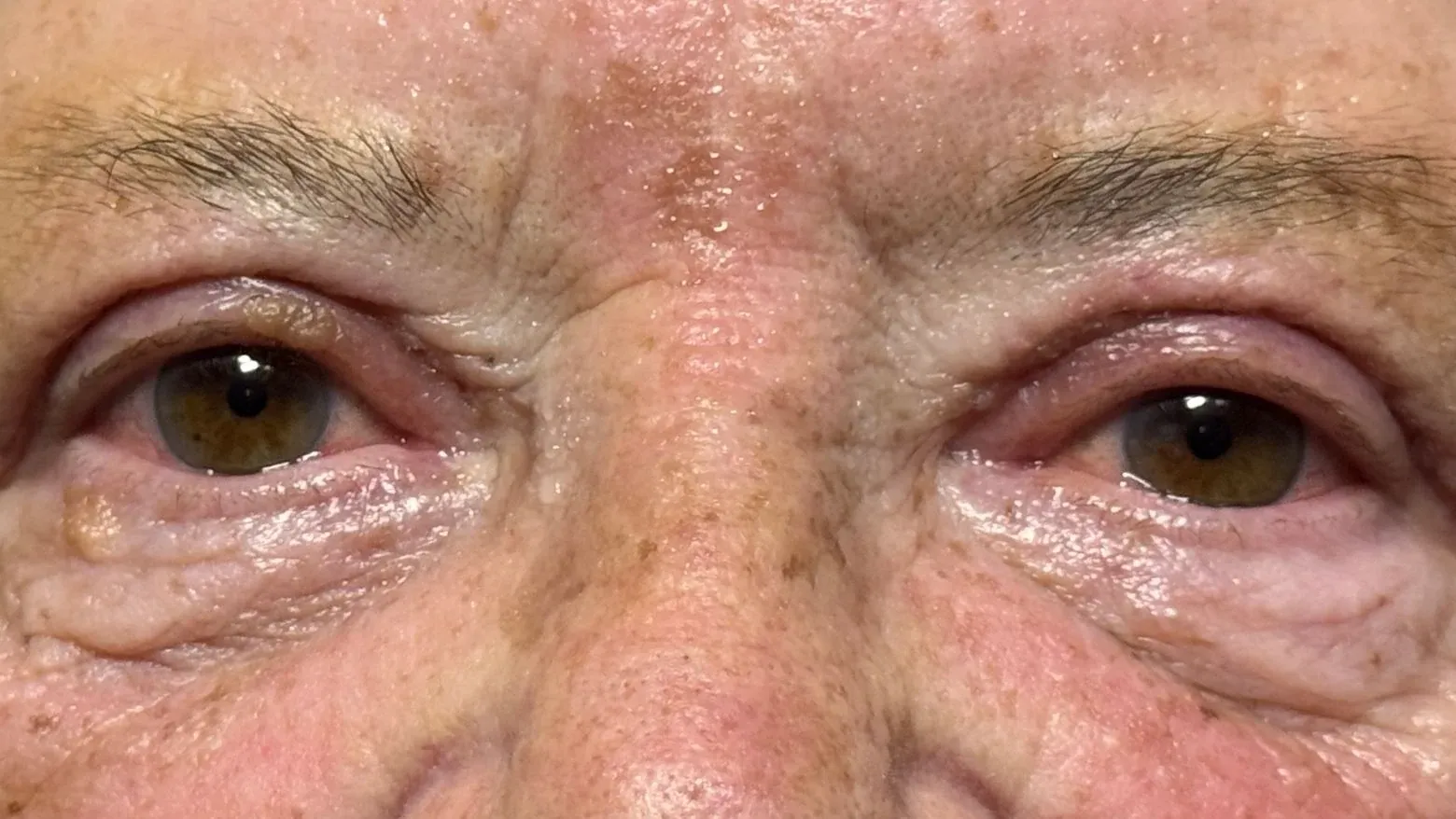
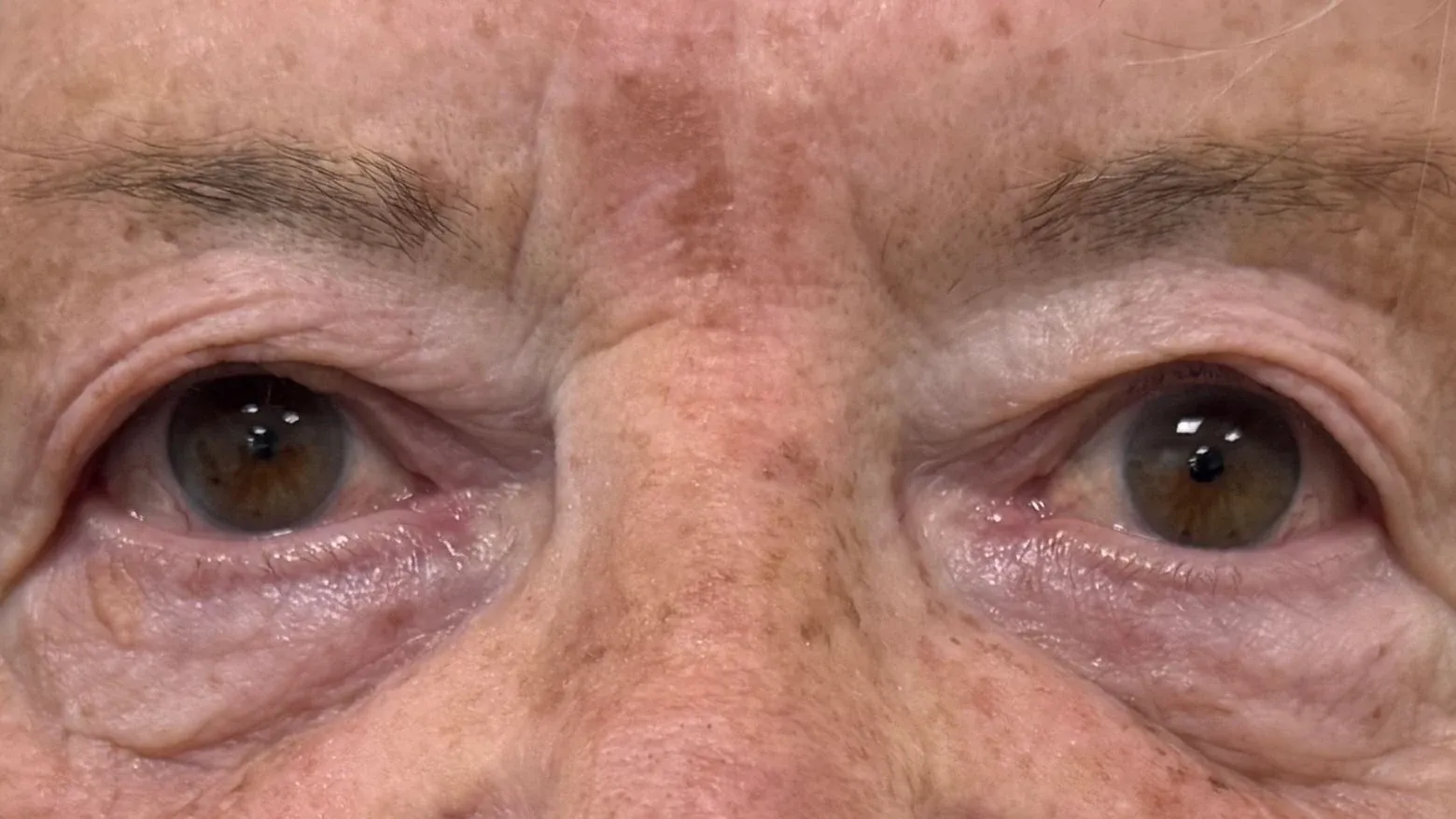
Recovery is usually straightforward. Bruising and swelling for one to two weeks, sometimes longer in older patients, with sutures out at about a week. Most people are presentable by three weeks and the result settles fully by three months. The scar sits in the crease and typically fades to a fine line that is difficult to find.
Removing skin from an eyelid is not technically difficult. Deciding how much to remove and from where, whether to touch the muscle or the fat, where the crease should sit, whether the brow needs addressing, whether there is a hidden droop, and whether the eye itself can tolerate any of it: that is where the result is determined.
There really is more to it than meets the eye.
Procedure pages this note touches on.
Repositioning a heavy or asymmetric brow, often the missing piece when upper blepharoplasty alone does not give the result you are after.
A drooping upper eyelid that obstructs vision, causes brow ache or simply looks tired. Surgery to lift the eyelid is highly successful when planned around your individual anatomy.
Removal of excess upper-lid skin and (where appropriate) a small amount of fat, refreshing the upper eye, opening up the gaze and lifting heavy lids.
Other recent notes.
Is eyelid surgery funded on the NHS?
There is no national rule. Whether an eyelid operation is paid for depends on which operation it is and which integrated care board your postcode sits in, and neighbouring boards reach opposite answers on the same patient. Here is how to find out where you stand.
Why do my eyelids look heavy?
Heavy upper eyelids are rarely caused by one thing. A Roman blind analogy for the three components that droop with age, and why treating only the obvious one disappoints.